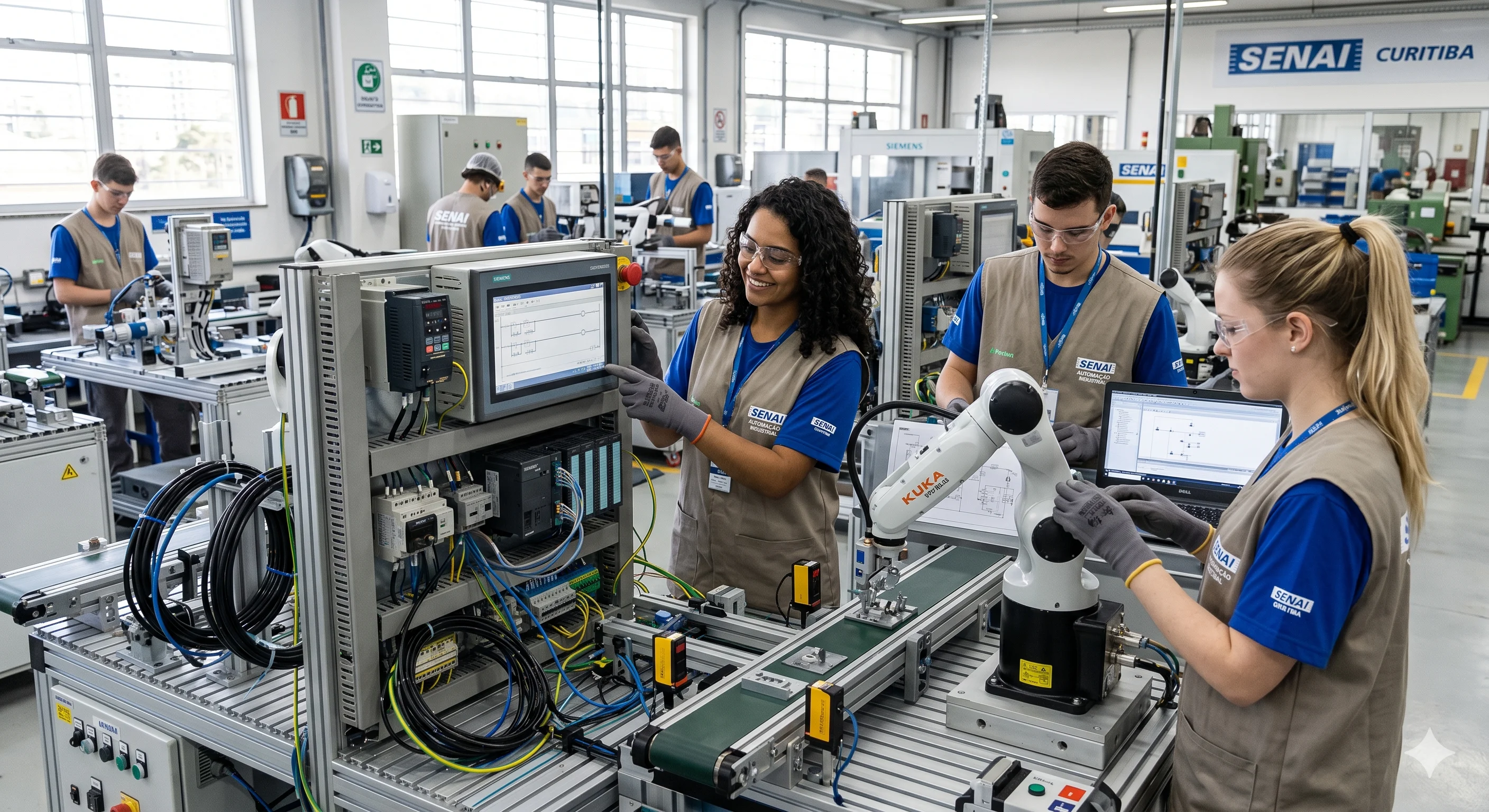
Have you ever stopped to think about how the products we use every day—from the cell phone in your hand to the cars on the road—are manufactured with such precision and on such a massive scale? The answer is simple, yet fascinating: industrial automation. If you’re looking for a career with high demand, attractive salaries, and a promising future, this could be the ideal path for you.
In this article, we’ll demystify what industrial automation is, why it’s at the heart of modern industry, and, most importantly, where you can take a course to become a sought-after professional in this field.
What Is Industrial Automation, Really?
Many people confuse automation with “robots replacing humans.” In reality, industrial automation is the use of control technologies, computer systems, and machines to manage industrial processes and operations. The main goal? To increase efficiency, ensure safety, and improve production quality by reducing human error and waste.
Imagine an assembly line where humans have to tighten thousands of screws every day. That’s exhausting, error-prone, and slow. With automation, sensors monitor the part’s position, robotic arms perform the task with millimeter precision, and software controls the conveyor belt’s speed. The automation professional is the mastermind behind this “orchestra” of machines.
Why is the automation market booming?
We are living in the era of Industry 4.0. It’s not just about machines, but about connectivity. Industries need professionals who know how to integrate systems, configure programmable logic controllers (PLCs), master robotics, and understand the Internet of Things (IoT).
Since companies need to produce faster and at lower costs to survive, the industrial automation specialist has become a strategic asset. It’s not just a “shop floor” job—it’s a high-level technical career that requires constant learning about new technologies.
What do you learn in the Industrial Automation program?
If you’re thinking about entering this field, know that the program is an exciting mix of theory and practice. You won’t just study from books; you’ll get hands-on experience with equipment you’ll encounter in the workplace.
Core Courses
Industrial Electricity and Electronics: This is the foundation of everything. You’ll understand how power supplies fuel the systems.
Programmable Logic Controller (PLC): The “brain” of the machines. This is where you’ll learn to program what each sensor or motor should do.
Instrumentation and Sensors: How do machines “sense” their environment? You’ll learn about temperature, pressure, level, and flow sensors.
Industrial Robotics: Assembly, maintenance, and programming of robotic arms and integrated automation systems.
Supervisory Control Systems (SCADA): How to monitor an entire factory via screens on a central computer.
Skills You’ll Develop
In addition to technical knowledge, the course focuses on logical reasoning and problem-solving. Often, a machine stops working due to a minor issue with a sensor or a flaw in the programming logic. Being an “industrial detective” is one of the most challenging and rewarding aspects of the profession.
Where can you take a course in Industrial Automation?
Choosing the right institution is crucial for your employability. In Brazil, we have leading institutions that are global benchmarks and carry significant weight on your resume for Google AdSense and the job market.
1. SENAI (National Industrial Apprenticeship Service)
Without a doubt, SENAI is the top choice in the country. It has the best infrastructure, with labs that simulate real-world industrial settings. A SENAI diploma is recognized and respected by HR departments at major multinational companies. You can find technical apprenticeship programs, high school-level technical courses, and technology-focused undergraduate programs in almost every state.
2. Federal Institutes (IFs)
Federal Institutes offer free, high-quality technical and technology programs. The admissions process may be more competitive, but the quality of education and theoretical foundation are excellent for those who wish to pursue an academic career or work at major engineering firms.
3. Private Engineering Colleges
If you’re looking for a full bachelor’s degree in Control and Automation Engineering, private colleges with high ratings from the MEC (Ministry of Education) are excellent options. Look for institutions that have partnerships with industries in your region, as networking during your internship is often what secures your first job.
Tips for Choosing the Best Institution
Check the labs: Automation is hands-on. Ask if the school has modern PLCs and industrial robots.
Consult alumni: Find out if the local job market values that institution’s degree.
Flexibility: If you’re working, look for institutions that offer blended or evening courses.
The Day-to-Day Life of an Automation Professional
Many people ask, “Will I be sitting in front of a computer all day?” The answer is: it depends. Automation professionals can work in a variety of roles.
There are those who focus on developing automation projects (more office/CAD work), those who handle integration and assembly (more hands-on work), and specialists in corrective and preventive maintenance (the ones called in when production stops). It’s a dynamic field where no two days are alike.
Is it worth investing in this career in 2026?
With advances in artificial intelligence and the need for increasingly sustainable industries, industrial automation professionals are the ones who will implement these changes. Sustainability relies on automation: machines that consume less energy, processes that waste fewer raw materials, and smart monitoring.
If you enjoy technology, are good with numbers, and want a career that isn’t replaced by AI but rather enhanced by it, you’ve found your calling.
Conclusion
Industrial automation isn’t just a choice of program; it’s a ticket to the forefront of global technology. Whether through a technical program at SENAI or a bachelor’s degree at a leading institution, investing in knowledge in this field ensures a prominent place in today’s job market.
Now that you know what it is and where to study, the first step is to find the educational institutions closest to you and check their enrollment schedules. The future of industry is being shaped right now, and you can be a part of it.
What about you? Have you ever thought about pursuing a career in industrial technology, or do you have any questions about the programs? Tell us in the comments about your experience or what you’re most curious about regarding this field!