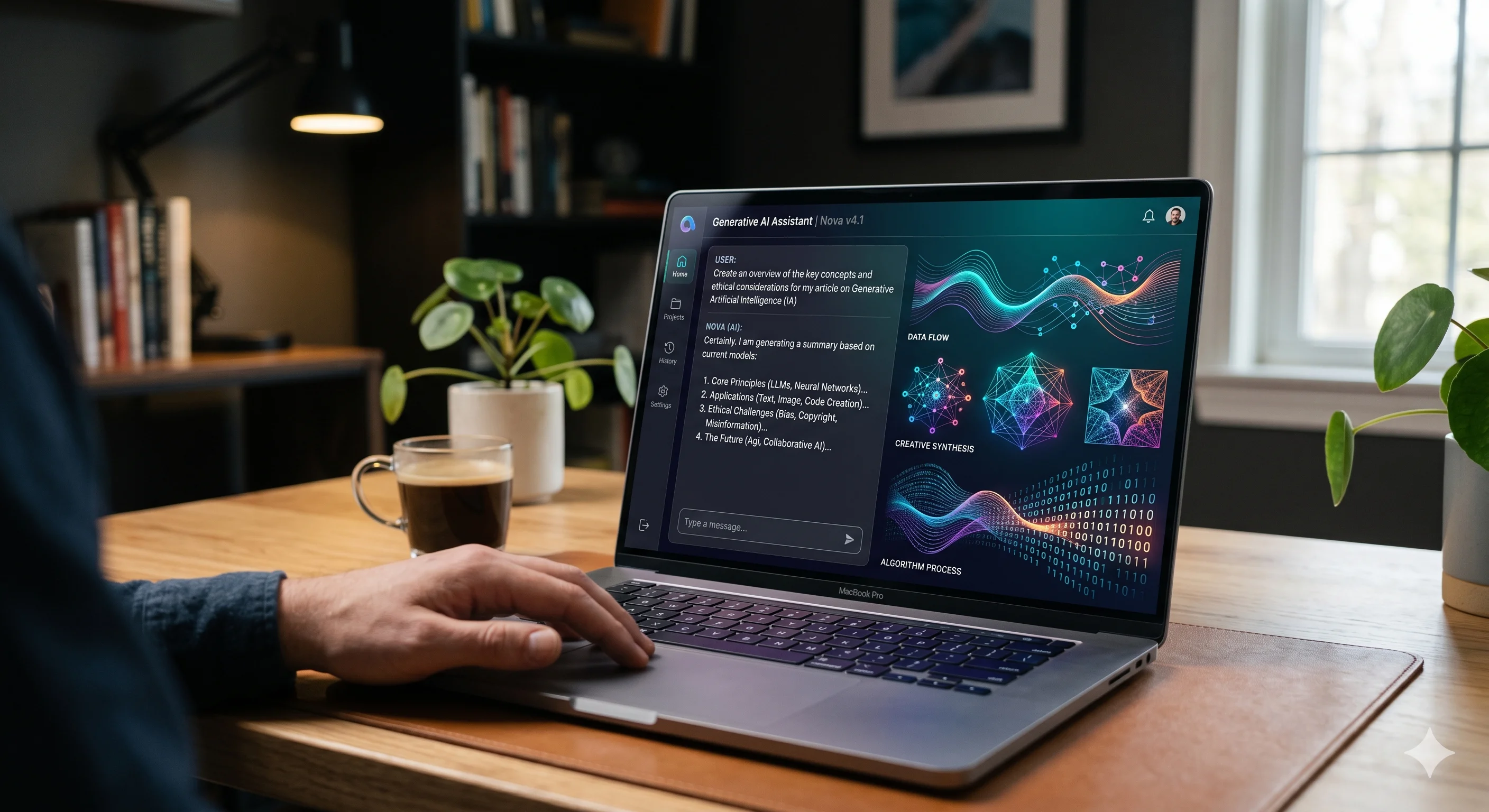
Imagine having a highly efficient personal assistant who not only answers your questions but also takes care of practical matters for you.
Someone you can ask to plan a trip, and instead of just getting a text with itinerary tips, you receive everything all set up. The assistant goes ahead and searches for flights, books the hotel, and puts together a complete spreadsheet on your Google Drive.
This is the great technological revolution we’re experiencing right now. We’ve left behind the era when Artificial Intelligence was only used to chat with us through chat windows.
Today, we’re diving headfirst into the fascinating era of autonomous agents. But what does this drastic change mean in practice for your daily life and your work?
In this article, we’ll explore this technological transition in depth. You’ll understand how we’ve moved beyond limited chatbots to create true executors of complex tasks in the digital environment.
Grab your coffee, sit back comfortably, and discover how AI is about to work for you in ways you’ve probably never imagined.
What Are Autonomous AI Agents?
To understand this new development without getting bogged down, we need to simplify the concept. Think of autonomous agents as the natural, proactive, and independent evolution of the virtual assistants we already know.
While a typical language model (such as a chatbot) waits for you to give a direct command to generate text, the agent goes far beyond this question-and-answer dynamic.
It is given a broad end goal and autonomously maps out the entire path needed to get there. It doesn’t need you to hold its hand and give instructions at every tiny step of the process.
You set the main goal, and the artificial intelligence itself breaks that big goal down into smaller, manageable tasks. It creates an action plan and begins executing it step by step.
For example, if you say, “Create the structure for a sales website,” a chatbot would only offer tips. A real agent will plan the website, write the code, test the features, find any errors, fix them on its own, and deliver the file to you, ready to go live.
It’s a radical paradigm shift in technology. We’ve definitively moved from “give me information on how to do this” to “please solve this for me right now.”
The Evolution: From Chatbots to Intelligent Agents
The trajectory of artificial intelligence in recent years has been rapid and impressive. It all started to become extremely popular with the arrival of large language models for the general public.
But if we look closely, the first systems that became a global sensation were, at their core, highly advanced and well-trained chatbots. They were brilliant, but passive.
The Limits of Traditional Chatbots
The chatbots that have recently captivated us are fantastic for exchanging ideas. They draft elegant emails, summarize massive texts in seconds, and explain difficult concepts with mastery.
However, they routinely run into an invisible and frustrating barrier: they are entirely reactive. In other words, they only do something when you prompt them and give an explicit command.
Furthermore, they exist in isolation within a text “box.” If you ask a traditional chatbot to buy a plane ticket, it will tell you in great detail exactly how you should do it yourself.
It will list the best websites and warn you about fees, but it lacks the “virtual hands” needed to go to the website, fill in your information, and click the button to confirm the purchase. It’s an advisor, not an executor.
The Leap Toward True Autonomy
It is precisely this limitation where revolutionary autonomous agents come into play. The major technological leap occurs when developers decide to give artificial intelligence digital “arms and legs.”
The global tech community realized that AI needed access to real-world tools to be truly useful. What if we connected the model directly to a web browser? What if we gave it access to the computer’s command terminal?
When this integration took place, the real magic began. The autonomous agent combines AI’s deep reasoning capabilities with the ability to perform actions on real-world systems.
From that moment on, it devises a solution, decides which external tool to use, clicks, types, evaluates whether the result was successful, and continues working until the project is successfully completed.
How Do Autonomous Agents Work in Practice?
The magic behind this impressive autonomy isn’t a science fiction plot—it’s pure, advanced software architecture. And the best part: the concept behind it all is very easy to understand.
Planning and Independent Reasoning
It all starts with a process that developers call “chain reasoning.” When the agent receives a difficult task, it pauses to think and creates a logical plan of action.
It thinks to itself: “Well, first I need to search for this information on the web. Then, I’ll open a spreadsheet. Next, I’ll extract the data from the website and fill in the correct columns.”
For this to work, the autonomous agent has short-term memory to remember what it just did, and long-term memory to learn from its own past mistakes.
If, along the way, a website goes down or a password fails, it doesn’t give up and freeze like old programs used to. It analyzes the error message, recalculates its route, and tries a different approach.
Use of External Tools
The most striking difference in practical use is native access to the tools we use every day. We humans use calculators, calendars, browsers, and notepads to work. Agents do too!
They’re programmed to understand their own limitations. The agent knows that if it needs to solve a very complex mathematical problem, it’s safer to open a digital calculator than to try to guess the result.
If they need to know today’s dollar exchange rate or tomorrow’s weather forecast, they activate a search tool, read the up-to-date results from the internet, and bring that fresh information into the workflow.
This completely eliminates the problem of knowledge frozen in time that older models suffered from. The autonomous agent is 100% connected to the real world—alive and constantly updating.
Examples of Tasks That Autonomous AI Already Performs
You’re probably wondering where all this technology is being applied today. The short answer is: in absolutely almost everything that can be done in front of a computer screen.
Let’s look at some key areas where autonomous agents are already demonstrating incredible execution power and time savings.
Programming and Software Development
In the field of technology and systems development, there are already agents that act as true junior software engineers. They work side by side with human developers, automating the grunt work.
You can ask the agent to create a simple script to download data from a competitor’s website. It opens the code editor, writes the logic, saves the file, and attempts to run the application.
If there’s a syntax error or library issue, the agent itself reads the error message that appeared in the terminal. It identifies where the error occurred, modifies the source code, and runs it again until it works.
This saves countless hours of code debugging and exhaustive testing. The human programmer acts only as a final reviewer, ensuring the quality of the finished system.
Market Research and Content Creation
For those working in digital marketing, SEO, or blogging, autonomous agents are a dream come true. They transform time-consuming workflows into tasks that take just a few minutes.
You can program an agent to monitor trends in your niche. It browses the internet on its own, finds trending keywords, assesses the competition, and generates weekly reports.
In addition, a properly configured agent can take that list of trends, find reliable sources, outline the topics for an article, and write the first complete draft of the content.
All of this happens in the background, while you focus on your business strategy or create eye-catching images to accompany your posts.
Project Management and Personal Organization
Imagine the power of connecting an intelligent agent directly to your corporate email and personal calendar. The chaos of daily organization simply disappears.
You can send a voice command saying, “Schedule follow-up meetings with all new clients who signed contracts last week.”
The autonomous agent will access your inbox, read the emails to identify the clients, cross-reference the information with your calendar, send the invitations, and send you a summary on WhatsApp when it’s done.
It can also analyze sales spreadsheets at the end of the month, create charts, format a polished PDF report, and send it to company executives—all without you having to open Excel.
Why Is This Change So Important?
The widespread adoption of autonomous agents will profoundly alter the dynamics of human productivity—something we haven’t seen since the popularization of the internet and smartphones themselves.
Until now, traditional technology helped us get things done a little faster. But we were still the sole operators of the machines. We were the ones responsible for clicking, dragging, and typing all day long.
With AI agents taking control of the tools, we’ve gone from being mere system operators to intelligence managers. You no longer perform the manual, repetitive tasks; you oversee the AI that performs them.
This shift in role frees up something priceless: our time. Think about it—how many hours of your workweek are spent on monotonous, bureaucratic tasks on the computer?
By delegating these tedious tasks to tireless agents, humans are completely free to focus on what machines have not yet mastered: empathy, creativity, strategy, and innovation.
The Future of Work with Executive AI
It’s very common and natural for people to fear that autonomous agents will replace professionals and take away jobs. Every technological revolution brings this kind of initial uncertainty.
However, the history of the labor market consistently shows us that technology transforms the nature of jobs but rarely eliminates the need for human labor entirely. Roles simply adapt and evolve.
The most valuable and well-paid skill in the near future will not be knowing how to click buttons in a specific software program. The true competitive advantage will lie in knowing how to instruct, manage, and review the work of an army of virtual agents.
Professionals who know how to delegate tasks clearly, create intelligent automation workflows, and integrate these AIs into companies’ routines will be in high demand on the global market.
Autonomous artificial intelligence will not replace the outstanding human professional. However, a human professional equipped with autonomous agents will certainly replace those who refuse to adopt the technology.
Conclusion
We’ve reached the end of our journey through this incredible universe of modern artificial intelligence. As we’ve seen throughout this article, the era of autonomous agents is no longer a distant promise; it has already begun and is here to stay.
We have definitively left behind the era when chatbots served merely as passive conversational encyclopedias. Today, we have robust tools at our disposal that plan, reason, and execute tasks in the real world.
Whether you’re building a complex system from scratch, organizing your busy schedule, or researching the best business opportunities online, autonomous AI is your newest and most powerful productivity partner.
Now is the perfect time to start learning about and testing these tools. Understanding how they work now will put you steps ahead of the vast majority of people, ensuring greater efficiency and more free time in your life.
And you—have you ever stopped to think about which tedious, repetitive task in your daily routine you’d love to delegate to an autonomous agent right now?
Tell us in the comments about your experience with automation or what your dream virtual assistant would be like. We’d love to read your ideas, answer your questions, and share lots of experiences with you there!